
 by Marcel Nanning |
Last Updated: October 26, 2026
The global CRM industry has grown at a pace that few enterprise software categories can match. The global customer relationship management market was valued at $112.91 billion in 2025 and is expected to grow from $126.17 billion in 2026 to $320.99 billion by 2034, registering a CAGR of 12.40% during the forecast period. That trajectory means one thing plainly: if your business manages customers, a CRM is no longer optional infrastructure; it is the operational backbone. Whether you run a small team or oversee a global enterprise, understanding the numbers behind this market helps you spend smarter, adopt faster, and avoid the pitfalls that sink even well-funded rollouts.
I have spent years reviewing CRM platforms and talking to the teams that use them daily, and the statistics heading into 2027 tell a more nuanced story than the headline figures suggest. The market is large and growing, AI is reshaping what these tools can do, and yet user adoption remains the single biggest obstacle to realising genuine ROI. This article pulls together the most reliable data available so you can act on it.
Key takeaways
- The market is heading towards $321 billion by 2034: According to The global customer relationship, the market is projected to expand from $126.17 billion in 2026 at a 12.40% CAGR, therefore any business delaying CRM adoption is competing against organisations that have already embedded these systems into their growth engine.
- 91% of companies with 10 or more employees already use a CRM: Per Wave Connect’s 2026 CRM statistics report, saturation among mid-size and large businesses is near-total, meaning the competitive advantage now lies in how well you use your CRM, not just whether you have one.
- ROI is real but context-dependent: Nucleus Research’s CRM ROI benchmark cites an average return of $8.71 per dollar spent, though more recent analysis places the figure closer to $3.10 as the market matures, still a 210% return, and well above most software categories.
- AI is the defining growth driver heading into 2027: SellersCommerce research shows the AI in CRM market reached $11.04 billion in 2025 and is projected to hit $48.4 billion by 2033, therefore, platforms without embedded AI capabilities are already falling behind.
- Implementation failure remains stubbornly high: According to Johnny Grow’s 2025 research, 55% of CRM projects fail to meet planned objectives, with poor user adoption as the primary cause, therefore budget for change management, not just the software licence.
Start here if you are:
A small business or start-up: Adopt a mobile-first cloud CRM with built-in AI features from day one. The data shows businesses leveraging mobile CRM are dramatically more likely to hit their sales targets, and the setup cost is low.
A growing mid-market company: Prioritise AI-assisted lead scoring and automated data entry before expanding to agentic workflows. Clean data is the foundation; everything else builds on it.
An enterprise: Focus on change management and cross-departmental CRM governance. Enterprise implementations fail at significantly higher rates than SMB rollouts, and the cost of failure scales with team size.
The global CRM market in 2026 and beyond
Market size and growth trajectory
The CRM market grew from $101.41 billion in 2024 to $112.91 billion in 2025, with Fortune Business Insights projecting $126.17 billion in 2026 and $320.99 billion by 2034 at a 12.40% CAGR. To put that in perspective, CRM now accounts for roughly 25% of all enterprise software spending globally, more than ERP, HR tech, or supply chain management combined.
Looking ahead to 2027, SellersCommerce’s market projections place the market at approximately $141.8 billion, continuing the 12-13% annual growth trajectory. The CRM market grew from $101.41 features, SME adoption, and the Asia-Pacific region, which means the headline number understates how much structural change is taking place inside the category.
Regional breakdown
North America held $35.75 billion in CRM revenue in 2025 and is projected to reach $39.15 billion in 2026, representing a 31.70% share of the global market. Europe accounted for approximately $28.29 billion in 2025, while Asia-Pacific, at $29.66 billion, is growing fastest, driven by digital transformation in India, China, and South-East Asia.
In Europe, UK CRM revenue is forecast to reach £1.9 billion by 2028, with GDPR compliance increasingly driving data-first CRM strategies across the region. For European businesses, this means the quality of data governance inside your CRM is now as commercially important as the features it offers.
The current rankings
Based on IDC’s Worldwide Semiannual Software Tracker for 2025, Salesforce leads with 20.00% market share, followed by Oracle at 4.10%, Microsoft Dynamics at 4.00%, Adobe at approximately 3.4%, and SAP at approximately 3.1%.

Salesforce’s 2025 CRM revenue was nearly five times that of its nearest competitor, and IDC has now ranked Salesforce the number one CRM vendor worldwide for 13 consecutive years. That said, vendors outside the top five held 65.4% of the market, up from 63.5%, showing how fragmented and competitive CRM has become.
Key shifts to watch
One of the more significant changes heading into 2027 is Oracle’s rise to second place. Oracle is now the number two CRM vendor. Microsoft had held that spot since 2022, but its share fell from 5.2% to 4.0% in 2025 while Oracle held steady at 4.1%.
For the SMB segment, the picture looks different. HubSpot holds 62% of SMB CRM installations, while Salesforce leads the mid-market at 46%. HubSpot ended June 2026 with 306,446 paying customers, roughly double Salesforce’s reported 150,000+, after 2025 revenue of $3.13 billion, up 19%.
POV!
-
I personally think it is mind blowing how fast HubSpot grew within the CRM-space. They first surprised marketing-tools with their introduction of Marketing Automation and the surrounding Inbound Marketing framework. As an owner of marketing- and techblogs I had the pleasure to be invited to their Inbound-event in Boston in 2016 and already impressed by their approach. Now they also penetrated the CRM-market and I am sure the existing market leaders are very nervous about this rapid rise. Inbound 2026 quotes.

Vide coding CRM
As AI technology becomes more accessible, an increasing number of companies are opting to code their own CRM systems. Leveraging AI’s capabilities, these businesses can develop tailored CRM solutions that precisely fit their unique operational needs. The rise of AI-powered coding platforms means that even companies without extensive software development resources can create sophisticated CRMs.
This trend underscores a shift towards more personalized and adaptable CRM solutions, driven by the democratization of AI technology.
However, in practice still a lot of work has to be done. Vibe code CRMs can couse serious security issues. Also, updating these types of CRM systems can be difficult. Read more about this in this article: why you should or should not vibe code your CRM.
AI investment is rewriting the CRM playbook
Adoption and market growth
In my experience reviewing CRM platforms over recent years, no shift has been as rapid or consequential as the integration of AI. The global AI in CRM market reached $11.04 billion in 2025 and is expected to grow to $48.4 billion by 2033. That is a 4x expansion in under a decade, driven by every major vendor embedding intelligence into core workflows.
83% of companies are already using AI features for smarter automation and personalised customer interactions in CRM, though the depth of that usage varies enormously. HubSpot’s 2025 survey of 1,000+ sales professionals found that only 19% of reps use AI features built directly into their CRM or sales tools, while 45% reach for general-purpose chatbots instead. The gap between broad AI adoption and CRM-native AI use is the real challenge for 2027.
What AI actually delivers
Nucleus Research found that AI-augmented CRM generates 52% higher productivity returns than non-AI CRM at equivalent cost levels, primarily through the time savings from automated data capture and the revenue lift from improved lead scoring. Companies that use AI for sales forecasting within their CRM report forecast accuracy of 80-85% versus 45-55% for manual forecasts. If your team is still building forecasts in spreadsheets, that accuracy gap translates directly into misallocated headcount and missed targets.
Salesforce Agentforce: the benchmark for agentic AI in CRM
The clearest signal of where CRM AI is heading comes from Salesforce’s own data. Agentforce ARR reached $800 million as of January 2026, up 169% year-over-year, with 29,000 deals closed and 2.4 billion agentic work units delivered, making Agentforce the fastest-growing product category in Salesforce history. Since then, the trajectory has continued: by the quarter ended July 2026 Agentforce had passed $1.5 billion in ARR.
Gartner projects 40% of enterprise applications will include task-specific AI agents by the end of 2026, compared with less than 5% two years earlier. Therefore, if you are renewing or selecting a CRM platform in 2027, agent capability should sit alongside traditional feature sets as a core evaluation criterion.
Also check out our articles about AI and CRM and how 50 CRM software vendors include AI in their products.

CRM adoption, ROI, and what the data means in practice
Adoption rates across business sizes
Nearly 91% of companies with 10 or more employees rely on CRM software to manage sales, marketing, and customer relationships. For smaller businesses, 71% of small businesses have adopted CRM systems, with 65% implementing within their first five years.
Industry adoption varies considerably. Technology companies lead CRM adoption at 94%, followed by manufacturing at 86%, education at 85%, healthcare at 82%, and human resources at 81%. If your sector sits near the lower end of these figures, there is a genuine competitive advantage available to early movers.
ROI: the honest picture
I have found that the ROI conversation around CRM tends to produce more heat than light, largely because several different figures circulate simultaneously. The most widely cited is $8.71 per dollar spent (Nucleus Research), while a more recent Nucleus analysis updates that to approximately $3.10 per dollar as the market matures. Both figures are meaningful. Even the conservative estimate represents a 310% return, well above the threshold for a worthwhile investment.
Most businesses report a 21%-30% increase in sales revenue after implementing CRM. On the productivity side, most businesses say CRM saves employees 5-10 hours per week, and 94% of businesses reported a surge in sales productivity after adopting CRM. On customer retention, CRM systems improve customer retention rates by up to 27% by centralising data and enabling proactive outreach.
The action here is straightforward: if your team is not tracking these metrics post-implementation, you cannot know whether your CRM is delivering. Set a baseline before go-live, measure at 90 days, six months, and one year.
Cloud and mobile: the deployment default
87% of businesses now use cloud-based CRM platforms, a jump from just 12% in 2008, showing a clear shift to cloud services. Cloud is no longer a preference; it is the default. On-premise CRM deployment continues but is gradually declining. It is now primarily used by organisations with strict data control and regulatory requirements.
Mobile access is increasingly significant. 70% of businesses use mobile CRM systems, which can improve productivity by 14.6%, and businesses leveraging mobile CRM are 150% more likely to exceed sales goals. Nucleus Research found that 65% of companies using a mobile CRM are achieving their sales quotas, compared with only 22% of businesses using non-mobile CRM. If your sales team is desk-bound by your CRM interface, that gap is worth addressing before 2027.
Why CRM implementations still fail, and how to avoid it
The failure rate is not improving
Johnny Grow’s 2025 research from Gartner and Forrester have long shown that 30-70% of CRM projects fail to deliver on their goals. More recent 2025 research from Johnny Grow puts the average failure rate at around 55%, when failure is defined as not meeting planned business objectives.
I have seen this pattern play out repeatedly when speaking with teams about their CRM history. The software rarely fails. The organisation does.
Where failures actually originate
60% or more of CRM implementation failures trace back to people-related challenges, adoption resistance, unclear ownership, and poor change management, not the technology itself. Only 6-10% of failures are attributable to actual problems with the CRM software. And yet most organisations spend roughly 80% of their implementation effort on technical configuration and only 20% on adoption and process work.
76% of CRM users say less than half of their organisation’s CRM data is accurate and complete. 37% of companies report losing revenue directly due to poor CRM data quality. The implication is clear: data quality is not a technical problem to solve at go-live. It is an ongoing discipline that requires ownership, processes, and accountability built into how your team works every day.
Frequently asked questions
How large is the CRM market expected to be in 2027?
SellersCommerce projects the CRM market will reach approximately $141.8 billion in 2027, continuing the 12-13% annual growth rate established through 2025 and 2026. The growth is driven primarily by AI feature adoption, expansion in Asia-Pacific markets, and increasing uptake among small and micro businesses that have yet to formalise their customer data management.
According to IDC data for 2025 Salesforce remained the CRM market leader for the 13th consecutive year, with 20.0% market share. It is followed by Oracle at 4.1% and Microsoft at 4.0%. However, by customer count rather than revenue, HubSpot leads among small businesses. The right measure depends on what you are evaluating, no single vendor dominates every segment.
What ROI should I expect from a CRM?
The most widely cited benchmark is $8.71 per dollar invested (Nucleus Research), with a more recent update placing that closer to $3.10 as the market matures. Businesses using CRM see a 29% increase in sales revenue, 27% higher customer retention, and a return of up to $8.71 for every $1 invested. ROI varies significantly based on implementation quality, user adoption rates, and how well the CRM integrates with existing tools. The 90-day post-launch period is typically where the gap between projected and actual ROI becomes visible.
How is AI changing CRM in 2026 and 2027?
AI is moving from a feature add-on to a core architectural layer. 65% of businesses have adopted CRM with generative AI features, with projections showing over 70% of all CRM platforms will be AI-integrated by the end of 2025. The most commercially significant development is agentic AI, autonomous AI that completes tasks rather than just assisting humans. Salesforce’s Agentforce product alone processed 2.4 billion agentic work units in FY2026, signalling that this is already a live commercial reality, not a future prospect.
Why do so many CRM implementations fail, and what can I do about it?
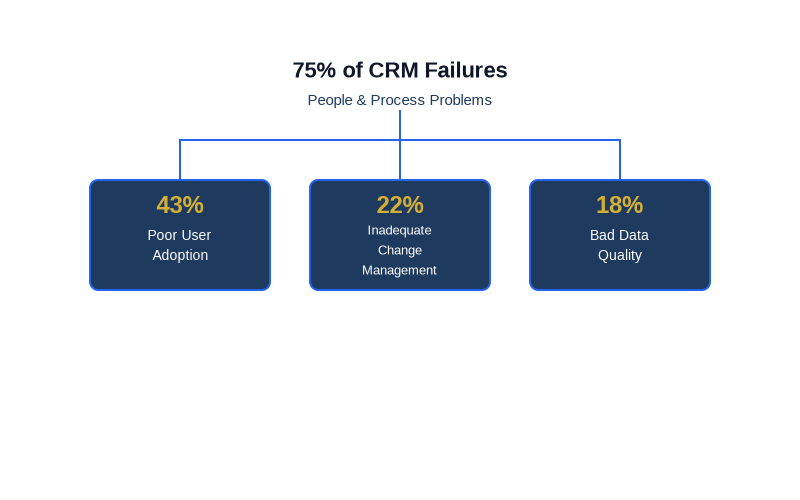
Over 75% of CRM failures trace to people and process problems. The three main causes are poor user adoption (43%), inadequate change management (22%), and bad data quality (18%). The most effective countermeasure is to treat your CRM rollout as a change management initiative rather than a software deployment. Assign internal champions, run role-specific training rather than generic demos, and measure adoption rates at the individual user level rather than just licence utilisation.
Recommended Reading
Direct Marketing
Direct Marketing, the defenition and strategies to be successful with it in combination with CRM. Read our tips!
Buying Behavior: The Definition
Buying behavior refers to what consumers or organizational buyers do when considering or making a purchase.
CRM for Marketing: 9 tricks for marketers to get more out of CRM in 2024
CRM for Marketing: 9 tricks for marketers to get more out of CRM in 2024: tips to get the most out of your CRM as a marketer
Quotation tips that will increase your scoring rate in 2026!
With these quotation tips, you will increase your scoring chances straight into 2026! Turn your quotation into a sales tool. Read more...
9 crm selection pitfalls and tips
There are a number of pitfalls lurking with a CRM selection. Avoid plunging into the CRM cloud unprepared!
The philosophy behind CRM software: more than just features
The philosophy behind CRM software: more than just features: use these insights from 15 years of experience with marketing, sales and CRM!